28 Coaching Conversations Your Team Should Be Having (But Aren't)
How archetype-matched peer coaching turns colleagues into growth partners
What if every person on your team had a personal communication coach? Not a hired consultant. Not an app. A colleague — someone who knows their work, understands their context, and has complementary strengths to share.
That's the idea behind archetype-matched peer coaching. And it's simpler than you think.
Why Peer Coaching Works Better Than Training
Traditional communication training treats everyone the same. A Storyteller and an Analyst sit through the same workshop, practice the same exercises, get the same tips. It's efficient. It's also mostly useless.
Ready to develop your team's voice?
Start a free trial →Peer coaching is different because it's relational. Two people with different communication archetypes don't just practice skills — they practice them on each other. The Storyteller learns data discipline from the Analyst. The Analyst learns narrative flow from the Storyteller. Both grow in ways a workshop can't replicate.
How Pair Coaching Works in ExecReps
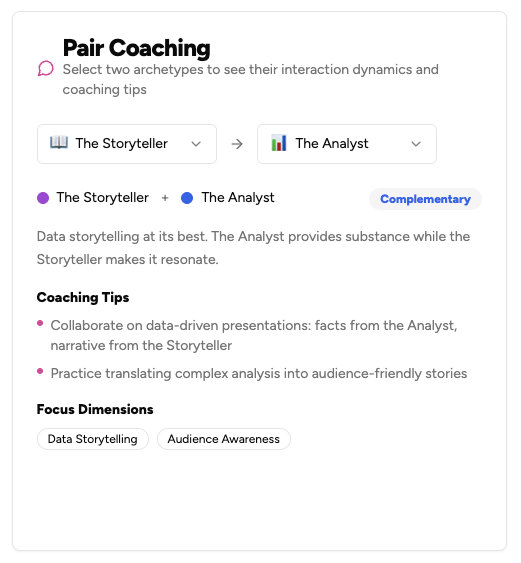
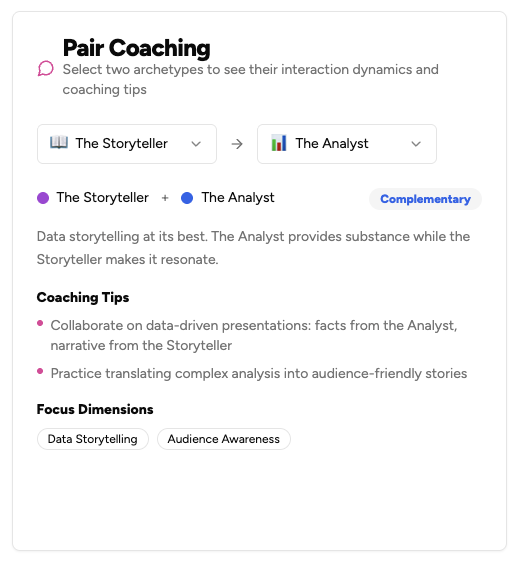
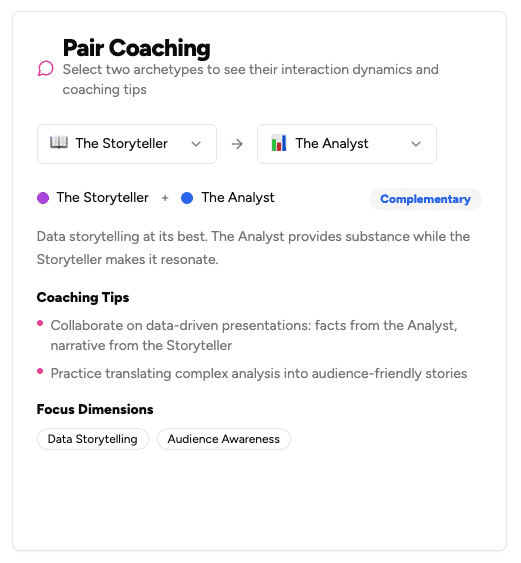
Select any two archetypes in the Pair Coaching panel, and you immediately see three things:
- The dynamic type — Synergy, Complementary, Creative Tension, or Neutral
- Coaching tips — Specific advice for how this pair can help each other grow
- Focus dimensions — The communication skills most relevant to their pairing
The 28 Pairings
With eight archetypes, there are 28 unique pairings (not counting self-pairs). Each one has a distinct dynamic. Here are some of the most powerful:
Storyteller + Analyst: Data Storytelling at Its Best
Dynamic: Complementary
The Analyst provides substance. The Storyteller makes it resonate. Together, they create presentations that are both rigorous and compelling. Their coaching agenda focuses on Data Storytelling and Audience Awareness — translating complex analysis into audience-friendly narratives without losing accuracy.
Maverick + Diplomat: Innovation Meets Influence
Dynamic: Creative Tension
The Maverick pushes boundaries. The Diplomat builds bridges. Left unstructured, this pair argues. With a coaching framework, the Maverick learns to package bold ideas in ways that build buy-in, while the Diplomat learns when consensus-seeking is actually holding the team back.
Mentor + Visionary: Wisdom Meets Ambition
Dynamic: Synergy
Both archetypes care about growth — the Mentor through individual development, the Visionary through collective possibility. Their coaching conversations naturally flow toward big questions: Where is this team going? How do we develop the people to get there?
Commander + Connector: Action Meets Alignment
Dynamic: Complementary
The Commander drives decisions. The Connector ensures everyone's on board. Their coaching helps the Commander slow down enough to bring people along, and helps the Connector develop the directness to push past endless alignment into actual execution.
Related Posts
How We Built a Coaching Match Algorithm That Actually Works
Most team coaching tools pair people randomly or by manager fiat. We built a scoring algorithm rooted in communication archetype dynamics, wrapped it in behavioral science that drives action, and grounded the coaching structure in learning theory that actually sticks.
7 min read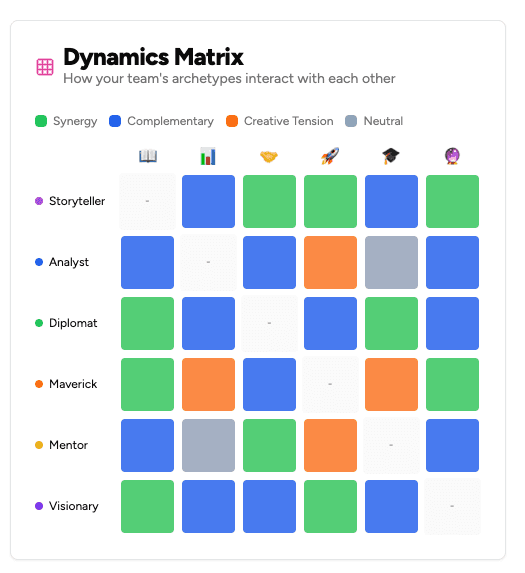
The Dynamics Matrix: Why Team Communication Is a Relationship Problem
Your team's communication issues aren't individual — they're relational. The Dynamics Matrix maps how every archetype pairing interacts, turning gut feelings about team chemistry into actionable intelligence.
4 min readGet insights from The Lab
Weekly research on voice science, executive communication, and leadership development. No spam, unsubscribe anytime.