The Dual-Axis Problem: Why Every Communication Assessment Has Been Lying to You
You can't fix what you can't see. And single-score systems are blind to half the picture.
Every communication assessment you've ever taken has lied to you.
Not deliberately. But by omission. They measured one thing and called it the whole picture.
Here's the lie: if you know your material, you're a good communicator. Full stop. Score high on content, get a pat on the back. But anyone who's sat through a board presentation by a brilliant engineer who couldn't hold a room knows that's not even half the story.
Ready to develop your team's voice?
Start a free trial →Communication is not one-dimensional. It never has been. And pretending it is creates a blindspot so large that entire leadership development programs fail without understanding why.
The Two Axes That Define Every Communicator
At ExecReps, we measure communication across two independent dimensions:
Content Knowledge — What you know. How well you apply frameworks, structure arguments, use data, and demonstrate strategic thinking. This is the "substance" axis.
Delivery Performance — How you say it. Your pace, fluency, clarity, vocal presence, and the mechanics of getting words from your brain to another person's understanding. This is the "signal" axis.
These two axes are independent. Being exceptional at one tells you almost nothing about the other. And that independence is the most important thing to understand about executive communication.
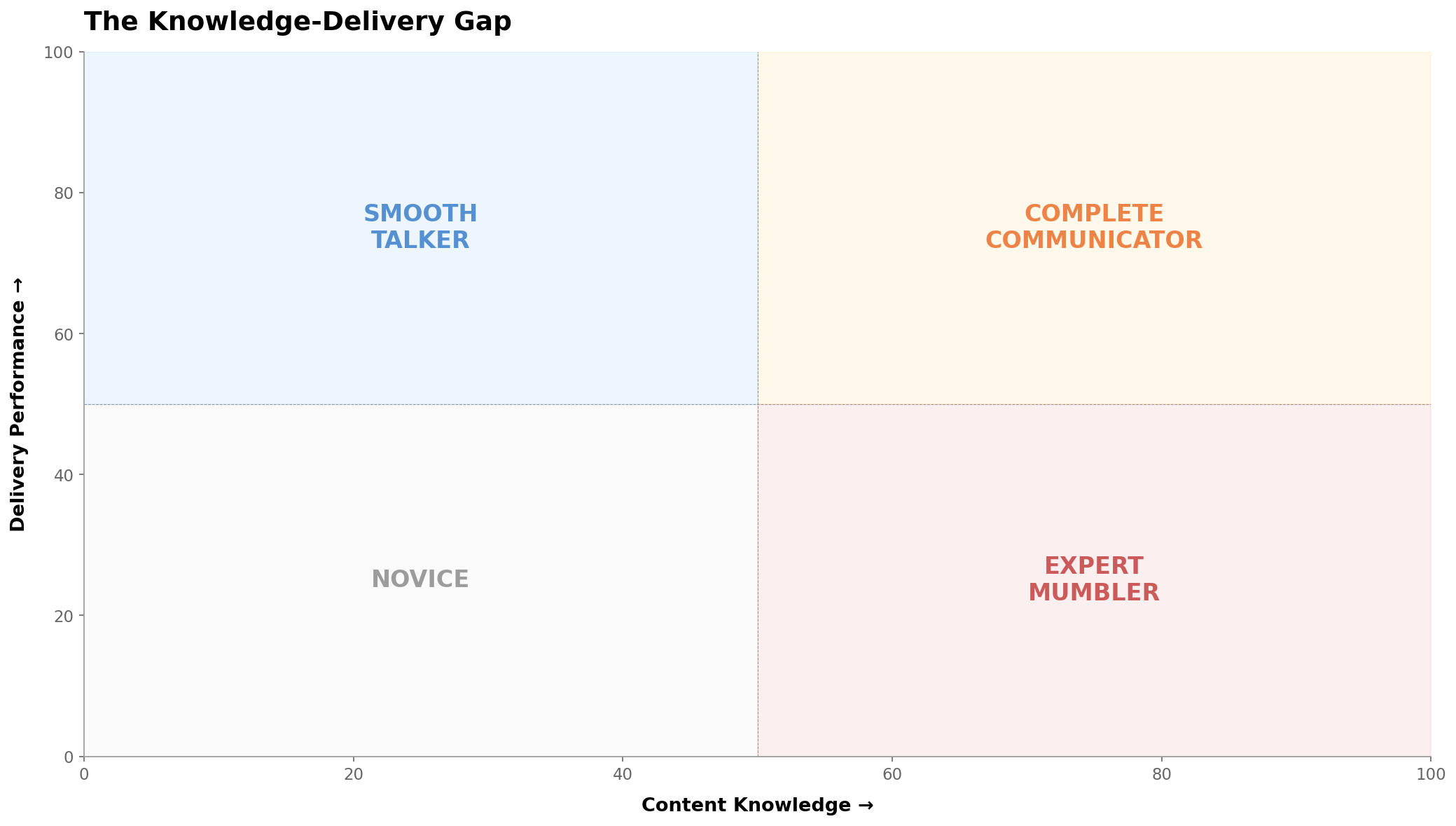
This creates four distinct quadrants. And where you sit determines what kind of development will actually help you.
The Four Quadrants
The Expert Mumbler (High Content, Low Delivery)
This is the largest group we see. By far.
Expert Mumblers are the VP of Engineering who knows the platform architecture better than anyone alive but loses the room in the first 90 seconds of their board update. They're the product manager whose strategy is brilliant but whose all-hands presentation puts people to sleep.
They know everything. They just can't land the message.
Traditional training misses them completely because their content scores are excellent. "Great material," the feedback says. Meanwhile, every audience they speak to checks out before the second slide.
The Smooth Talker (Low Content, High Delivery)
Smooth Talkers are charismatic. They command a room. Their voice resonates, their pacing is impeccable, and they project confidence that makes people lean in.
Until the Q&A starts.
Under pressure, their frameworks collapse. Their data is thin. Their strategic thinking doesn't hold up to scrutiny from anyone who actually knows the domain. They sound like leaders. But when challenged, the substance isn't there.
Traditional training misses them too, but for the opposite reason. Their delivery scores are so high that feedback focuses on "great presentation skills" while ignoring the structural weakness underneath.
The Novice (Low Content, Low Delivery)
Early career. Early in their journey. This is where everyone starts. There's no shame here — only a clear development path forward. And critically, that path needs to develop both axes simultaneously, not just one.
The Complete Communicator (High Content, High Delivery)
Rare. Only about 4% of professionals we assess land here naturally. They know their material and they know how to make it land. Their arguments are structured, their delivery is compelling, and they hold up under pressure.
This is the target. But the path to get here looks completely different depending on which quadrant you start in.
The Data: Where Professionals Actually Fall
When we plot assessment results across both axes, the pattern is stark.
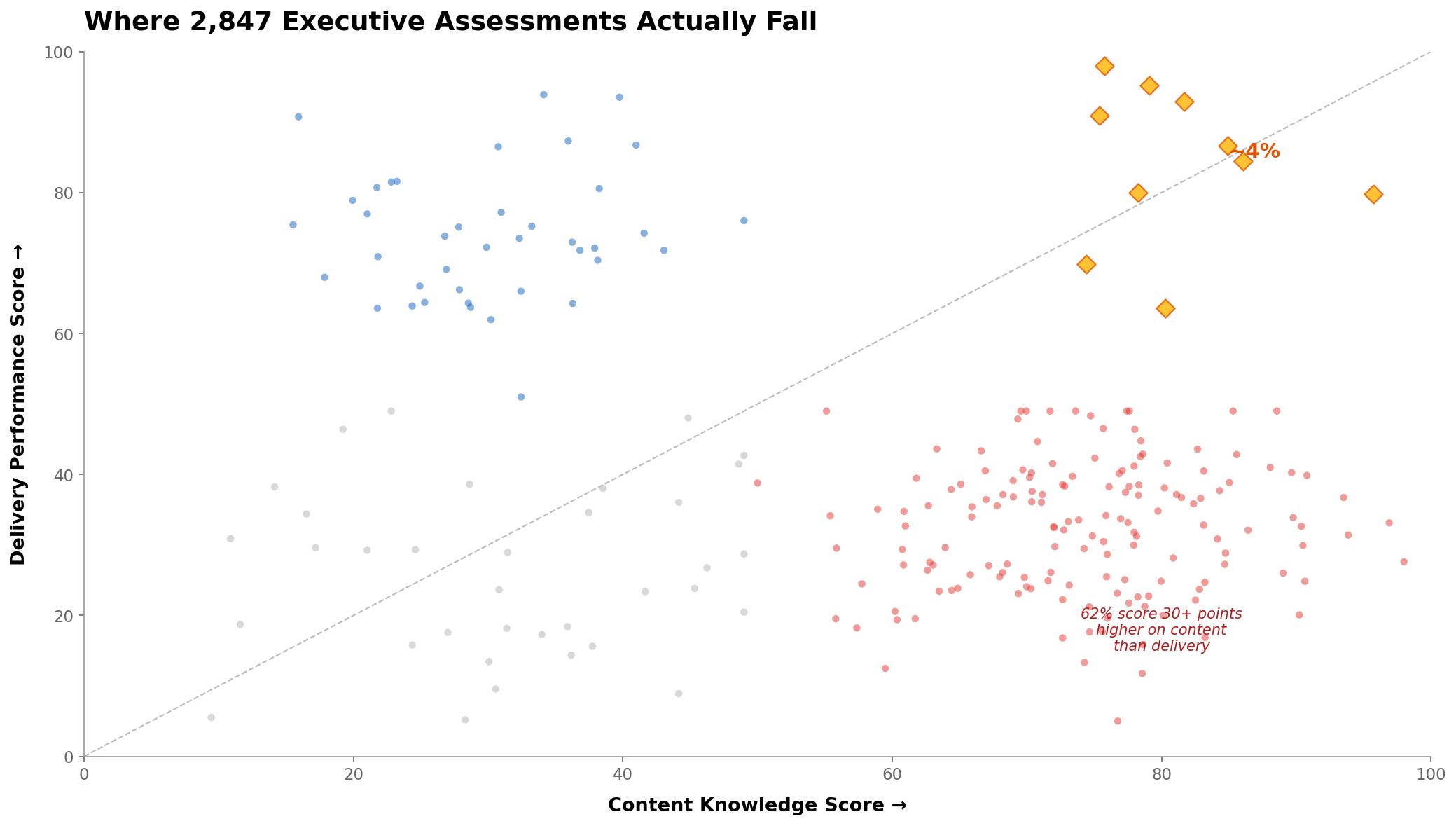
The majority cluster in the bottom-right: high content, low delivery. These are the Expert Mumblers. 62% of professionals we've assessed score 30 or more points higher on content than delivery.
A smaller but significant cluster sits top-left: the Smooth Talkers. High delivery, thin content.
Very few sit on the diagonal. Very few are naturally balanced.
And the Complete Communicators? Those gold diamonds in the top-right? They represent roughly 1 in 25 professionals. The rare combination of knowing your material and delivering it with impact.
This isn't a skills gap. It's a measurement gap. We've been training the wrong axis because we could only see one.
The Blindspot: What Single Scores Hide
Here's where it gets personal.
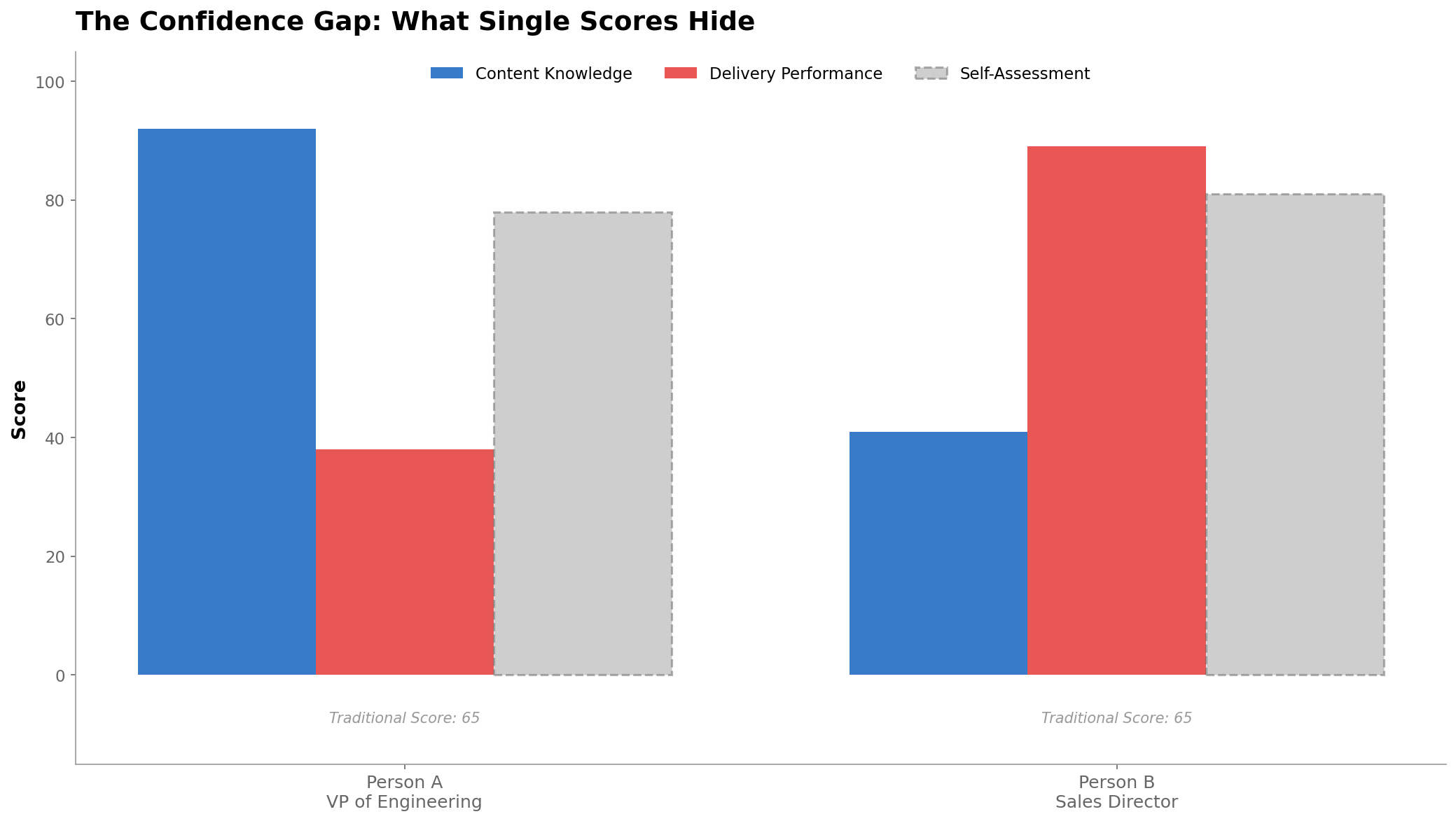
Consider two professionals. Person A — a VP of Engineering — scores 92 on content and 38 on delivery. Person B — a Sales Director — scores 41 on content and 89 on delivery.
In a traditional assessment that blends these into a single number? They both score 65. Same number. Same feedback. Same development plan.
That's insane.
Person A needs delivery coaching — pacing exercises, vocal warmups, presentation practice. Give them more content training and you're polishing a trophy that's already shining while the foundation crumbles.
Person B needs content depth — framework mastery, structured reasoning, domain expertise drills. Send them to a "presentation skills" workshop and you're sharpening a sword that already cuts while the strategy behind it stays dull.
Single-score systems create the illusion of measurement. Dual-axis systems create actual insight. The difference isn't academic. It determines whether your training budget produces results or produces reports.
Two Paths to the Same Place
Once you know which quadrant someone occupies, their development path becomes precise.
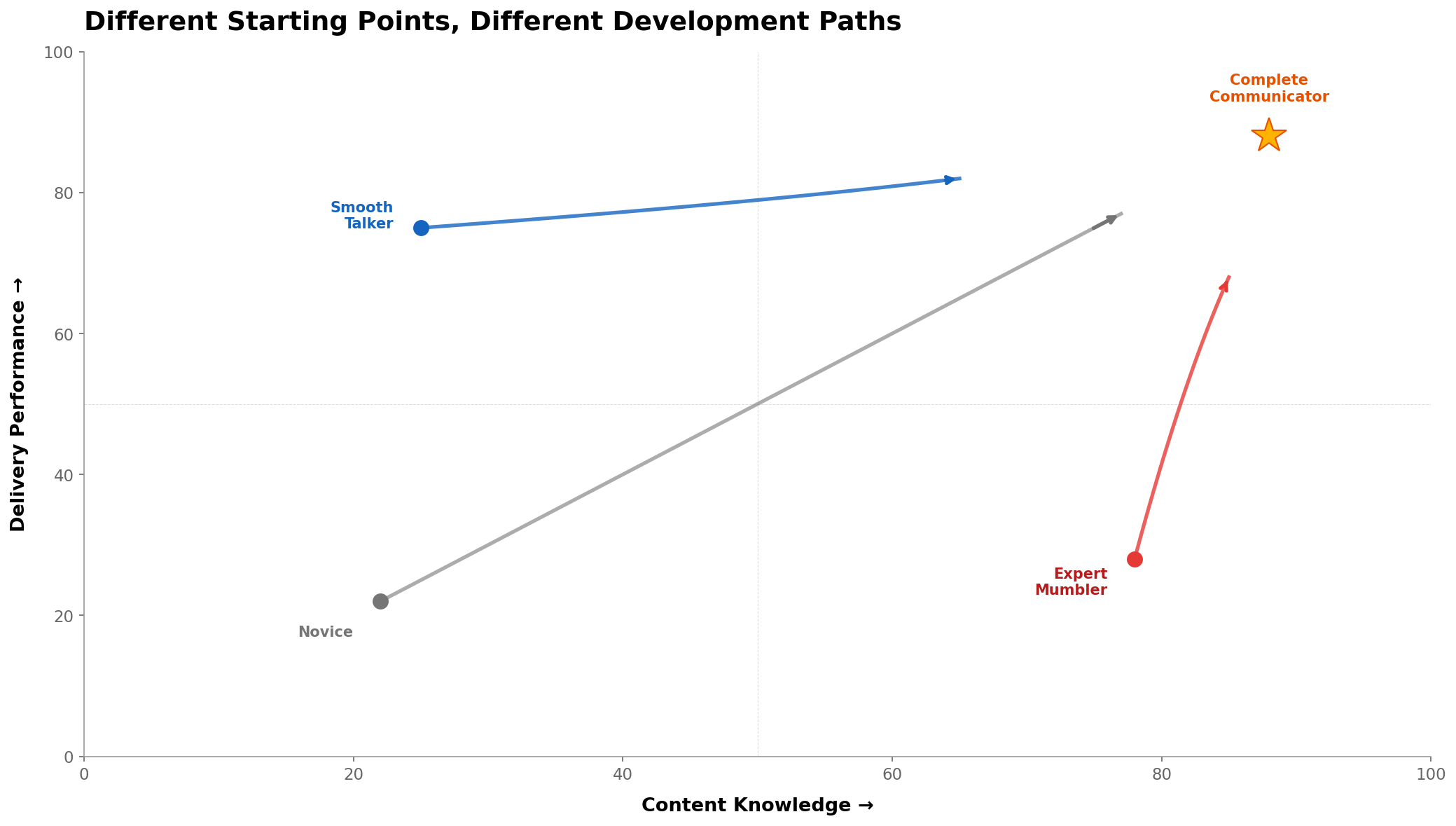
Sarah, a VP of Engineering, starts at week 1 with content mastery at 80% but delivery performance at just 25%. She knows her material cold. She mumbles through every board meeting. Her path is almost entirely vertical — driving delivery performance up while maintaining the content strength she already has.
Marcus, a Sales Director, starts with the opposite profile: delivery at 75% but content at just 30%. He's a charismatic presenter whose frameworks fall apart under questioning. His path is almost entirely horizontal — building content depth while maintaining his natural delivery gifts.
Related Posts
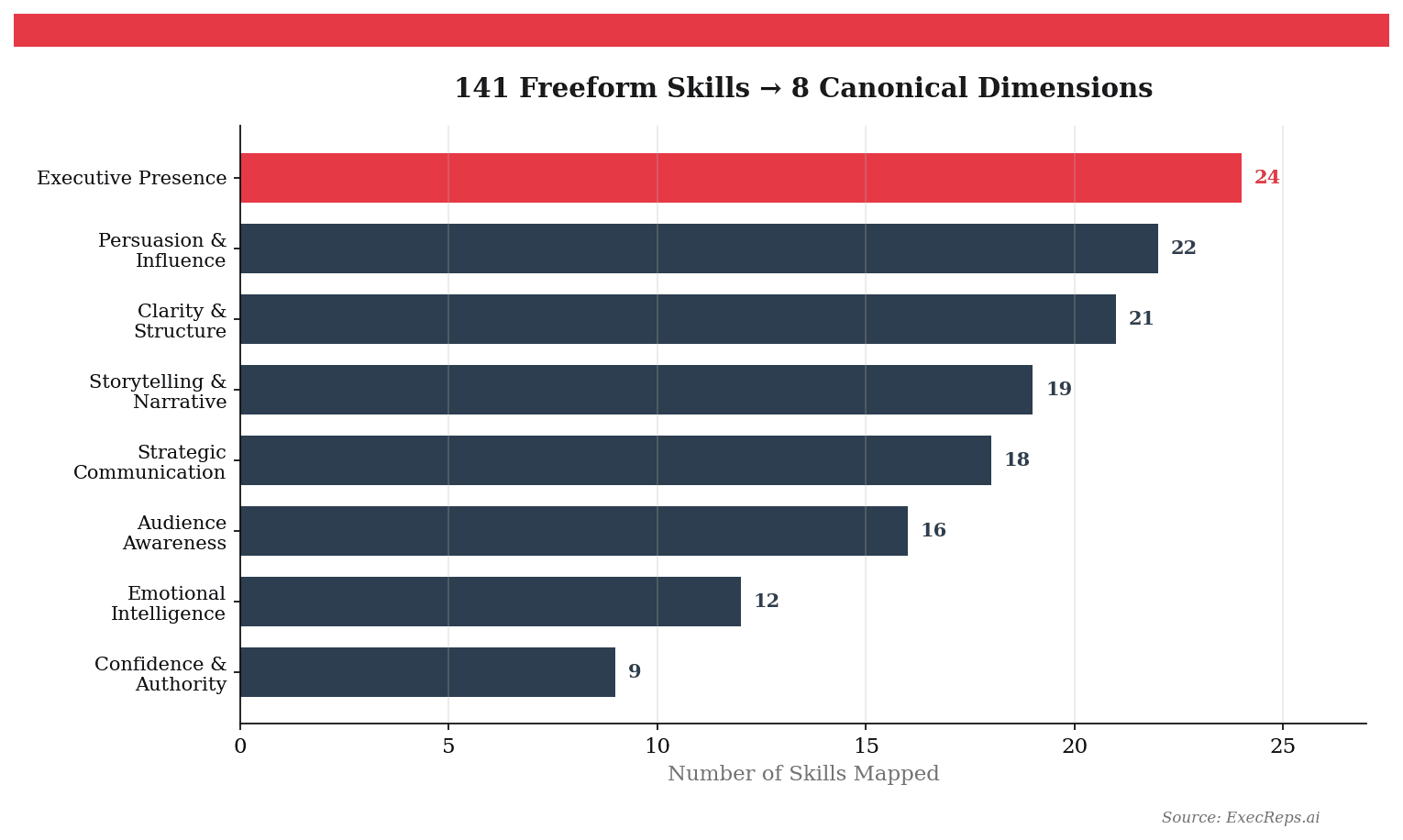
How We Mapped 141 Freeform Skills to 8 Validated Dimensions
When your learning platform has 141 different skill labels, you can't build recommendations, track gaps, or show progress. Here's how we used O*NET, WEF, and Gemini embeddings to create a validated taxonomy — and why framework grounding matters more than model size.
7 min read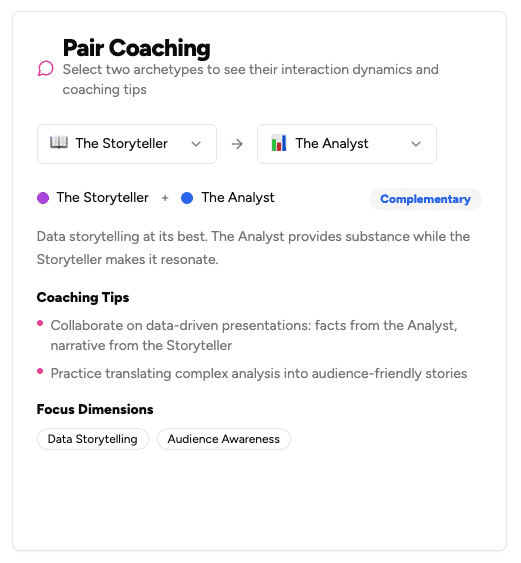
How We Built a Coaching Match Algorithm That Actually Works
Most team coaching tools pair people randomly or by manager fiat. We built a scoring algorithm rooted in communication archetype dynamics, wrapped it in behavioral science that drives action, and grounded the coaching structure in learning theory that actually sticks.
7 min readGet insights from The Lab
Weekly research on voice science, executive communication, and leadership development. No spam, unsubscribe anytime.