
The ExecReps Business Case: How to Build an ROI Report Your CFO Will Approve
Part 2 of The Champion's Playbook Series
The ExecReps Business Case: How to Build an ROI Report Your CFO Will Approve
You already know your team needs better communication skills. You’ve seen the signs — the meetings that should have been emails, the brilliant engineers who can’t land a cross-functional pitch, the high-potential manager who keeps getting passed over because she “doesn’t have executive presence yet.” (If you haven’t done the diagnostic yet, start with Do We Have a Communication Problem? — it’ll give you the data to ground this conversation.)
But knowing isn’t the hard part. Getting budget is.
This post is your playbook. By the end, you’ll have every number, every talking point, and a ready-to-customize business case template that turns your instinct into an investment thesis. Let’s build the case that gets a “yes.”
Ready to develop your team's voice?
Start a free trial →Communication Is Infrastructure, Not a Perk
Here’s the uncomfortable truth most L&D budgets ignore: communication is the multiplier on every other investment you make.
You spend on tools. On process improvements. On technical upskilling. On product training. But none of that investment reaches its potential if the people you trained can’t articulate what they learned — to clients, to leadership, to each other.
Think about it:
- Your engineers complete an architecture certification, but can’t clearly present trade-offs in a design review. Wasted ROI on the cert.
- Your sales team masters the new CRM, but stumbles through discovery calls. Wasted ROI on the tool.
- Your managers attend a leadership offsite, but can’t cascade the new strategy to their teams with clarity. Wasted ROI on the offsite.
Communication isn’t a “soft skill.” It’s the delivery mechanism for every hard skill you invest in. And right now, 0% of mid-level professionals receive structured communication development. The C-suite gets executive coaches at $500–$1,000 per hour. Everyone else gets a vague note in their performance review: “Could improve communication.”
That’s not a development plan. That’s a shrug.
The Cost of Bad Communication (It’s Higher Than You Think)
Let’s stop speaking in abstractions. The data on communication breakdowns is staggering — and it gives you exactly the ammunition your CFO needs.
The Macro Picture
- $1.2 trillion per year — that’s what poor communication costs U.S. businesses annually, according to a Grammarly and Harris Poll study. Not a typo. Trillion.
- 7.47 hours per week — the average knowledge worker loses nearly a full workday every week to unclear communication: deciphering ambiguous messages, attending unnecessary meetings, redoing work because of misalignment (Grammarly/Harris Poll, 2023).
- 56% of project budget at risk — the Project Management Institute found that ineffective communication is the primary cause of project failure, putting more than half of every project dollar in jeopardy.
The Costs You Feel But Don’t Measure
Beyond the headline stats, there are costs hiding in your org chart right now:
- Turnover from feeling unheard. Employees — especially diverse talent — leave organizations where they feel their voice doesn’t carry weight. Replacing a mid-level employee costs 50–200% of their annual salary. How many departures last year were really about “culture fit” when they were actually about communication equity?
- Missed deals from weak presence. Your team knows the product inside and out, but the prospect chose a competitor whose team presented with more confidence and clarity. One lost enterprise deal can dwarf an entire year of training investment.
- Slow decisions from unclear escalation. When people can’t communicate a recommendation concisely, leadership asks for another meeting, another deck, another round of clarification. Multiply that by every decision across the org.
- Innovation bottleneck. Great ideas die in poorly structured pitches. The person with the breakthrough insight gets steamrolled by the person with the louder voice — not the better argument.
These aren’t hypothetical. They’re happening in your organization this quarter.
How to Calculate YOUR Team’s Communication Cost
Here’s where this gets personal — and powerful. Walk through this formula with your own numbers, and you’ll have a figure that makes the business case write itself.
Step 1: Quantify the Time Waste
(Average fully-loaded salary) × (hours lost to miscommunication per week) × 52 weeks
= Annual Communication Waste per Employee
Example: A team of 25 with an average salary of $95,000:
- Fully-loaded cost (salary + benefits + overhead): ~$130,000/year
- Hourly rate: ~$62.50/hour
- Hours lost to miscommunication per week: 7.47 (industry average)
- Per employee: $62.50 × 7.47 × 52 = $24,268/year
- For a 25-person team: $24,268 × 25 = $606,700/year in communication waste
Even if you’re conservative and cut the industry average in half — say your team only loses 3.5 hours per week — you’re still looking at over $280,000 annually for a 25-person team.
Step 2: Add the High-Impact Events
Now layer on the one-time costs that communication failures trigger:
- One bad hire from a poorly assessed interview (hiring manager couldn’t probe effectively, candidate couldn’t articulate experience): $50,000–$150,000 in recruiting, onboarding, and productivity loss
- One lost deal from a weak client presentation or proposal defense: $50,000–$500,000+ depending on your average deal size
- One preventable departure of a high performer who didn’t feel heard: $65,000–$190,000 in replacement costs
Step 3: Total It Up
Annual communication waste (Step 1)
+ Cost of one bad hire
+ Cost of one lost deal
+ Cost of one preventable departure
= Total Addressable Communication Cost
For our 25-person example, even conservatively:
| Cost Category | Estimate |
|---|---|
| Annual time waste (25 people) | $606,700 |
| One bad hire | $75,000 |
| One lost deal | $100,000 |
| One preventable departure | $95,000 |
| Total Addressable Cost | $876,700 |
Now Compare That to ExecReps
ExecReps Starter plan for 25 seats: $10,000/year.
That’s $400 per person per year — roughly 1.1% of the cost of the problem it solves.
Even if ExecReps only recovers 5% of that communication waste, you’re looking at a 4:1 return. Recover 10%, and it’s nearly 9:1. The math isn’t close.
For comparison: - A single executive coach: $500–$1,000/hour × 10 sessions = $5,000–$10,000 per person - ExecReps: $400/person/year with unlimited practice sessions, AI-scored feedback across 8 skill dimensions, and team-wide analytics
The DEI Case: Communication Equity as a Budget Strategy
If your organization has a DEI or Belonging budget — and most mid-to-large companies do — ExecReps fits naturally as a line item. Here’s why.
The Problem With “Just Speak Up”
Traditional advice for underrepresented professionals is some version of: “You need to speak up more in meetings.” That advice puts the burden on the individual while ignoring the systemic barriers: accent bias, cultural communication norms, lack of access to the coaching networks that come naturally to people who already look and sound like leadership.
ExecReps flips this:
- Voice equity. AI-powered coaching that was previously available only to C-suite executives (at $500+/hour) is now accessible to every team member at $400/year.
- Accent-neutral scoring. ExecReps evaluates clarity, structure, brevity, and presence — not accent, tone of voice, or cultural speaking patterns. We don’t change how people sound. We make them more powerful as they sound.
- Structured practice for structured confidence. Scenario-based workouts give everyone a safe space to practice high-stakes communication — not just the people who are comfortable “winging it” in front of the group.
- Privacy-first design. Voice recordings are transcribed immediately and never stored. No one is being surveilled — they’re being developed.
Budget Positioning
ExecReps can be positioned under multiple budget categories:
- DEI/Belonging budget — communication equity, inclusive talent development
- L&D budget — skills development, leadership pipeline
- Team performance budget — productivity, collaboration effectiveness
- Manager development budget — people leadership skills
This flexibility is a feature, not a workaround. Communication development is DEI work. It is performance work. It is leadership development. Choose the budget line that has the most room — or split it across two.
Related Posts

Do We Have a Communication Problem? 7 Signs Your Team Has a Skills Gap Hiding in Plain Sight
Brilliant work is going unnoticed because your team can't articulate it. Here are the telltale signs of a communication skills gap — and what modern teams are doing to close it.
10 min read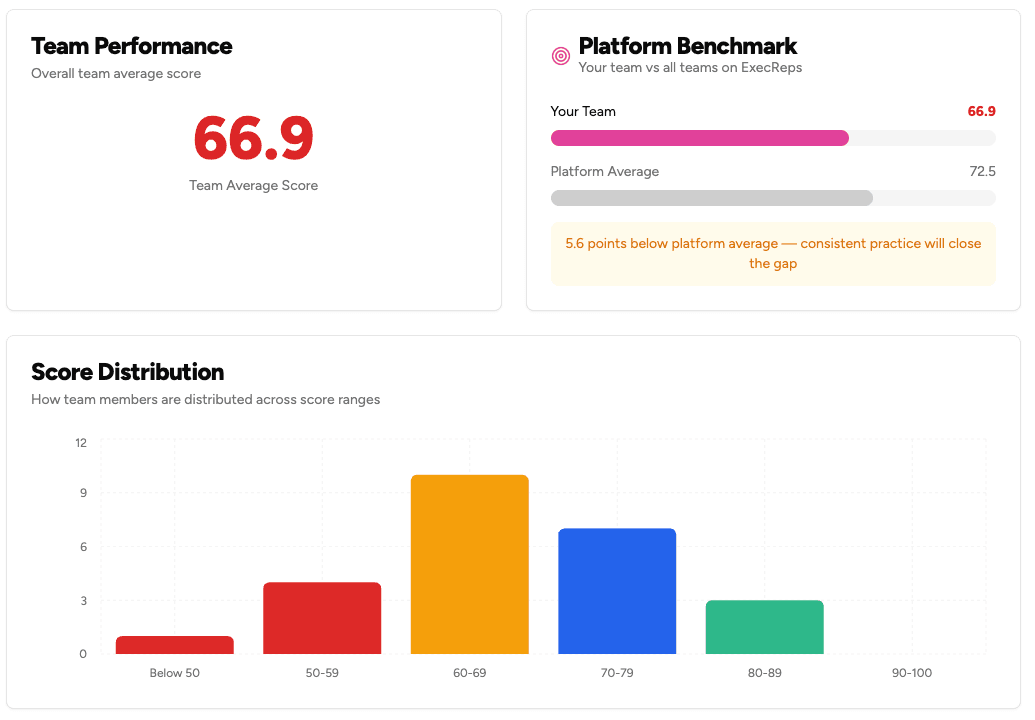
The Dashboard That Changes Everything: Why Team Communication Analytics Matter
Most teams fly blind on communication quality. ExecReps Team Analytics gives leaders the visibility to spot patterns, close gaps, and build genuine communication culture — not just hope for it.
5 min readGet insights from The Lab
Weekly research on voice science, executive communication, and leadership development. No spam, unsubscribe anytime.