
Launching Your First Team on ExecReps: The 30-Day Playbook
Part 3 of The Champion's Playbook Series

You Got the Budget. Now What?
Congratulations — you made the case, got the sign-off, and secured a pilot for your team. (If you haven’t yet, our business case guide walks you through the ROI math that gets budget approved.)
Now comes the part that actually matters: making it work.
Here’s the uncomfortable truth about L&D programs — most of them die in the first two weeks. Not because the tool was bad, but because the rollout was. A brilliant platform introduced the wrong way to the wrong team at the wrong time becomes shelfware. And shelfware doesn’t get renewed.
Ready to develop your team's voice?
Start a free trial →But you’re reading this, which means you’re not leaving adoption to chance. Good.
This is your 30-day playbook for launching ExecReps with your first team. It’s built on behavioral science, real rollout patterns, and the hard-won lessons of champions who’ve done this before. Follow it week by week, and by Day 30, you won’t just have participation data — you’ll have a team that’s measurably better at communicating and the analytics to prove it.
Step Zero: Pick the Right First Team
Before you send a single invite, you need to make the most important decision of the entire rollout: which team goes first.
This choice will determine whether ExecReps spreads through your organization or stalls after one pilot. Get it right, and your first team becomes your proof of concept, your case study, and your internal evangelists. Get it wrong, and you’ll spend months explaining away lukewarm results.
Who NOT to pick
- Not your weakest communicators. Starting with the team that “needs the most help” feels logical, but it frames the tool as remediation. People sense that. Resistance goes up, engagement goes down, and your pilot data looks terrible.
- Not your strongest communicators. They’ll complete one workout, see a high score, and say, “I already know this.” You need a team with room to grow and the motivation to grow into it.
Who TO pick
Look for a team that checks at least three of these boxes:
- Facing a visible challenge. A reorg, a new client portfolio, an upcoming board presentation, a product launch. Teams with a reason to get sharper right now have built-in motivation.
- Led by a supportive manager. This is non-negotiable. You need a manager who will champion the tool, not just approve it. More on this in a moment.
- Sized between 5 and 10 people. Small enough to rally as a group, large enough to generate meaningful team analytics and social proof for expansion.
- Contains people who’ve received “speak up more” feedback. These are the people who know they need to develop but have never had a structured way to do it. Remember: 0% of mid-level professionals receive structured communication development. ExecReps is the thing that didn’t exist for them before.
The ideal first team isn’t your biggest problem — it’s your biggest opportunity.
How to Introduce It Without Creating Resistance
You’ve picked the team. Now, how you introduce ExecReps matters as much as which team you picked. The framing in the first five minutes will shape every interaction that follows.
Frame it as access, not remediation
The single most important messaging shift: this is not “training for people who need help.” This is access to the kind of development that was previously reserved for executives.
“Executive coaches charge $500 to $1,000 an hour, and they’re reserved for the C-suite. ExecReps gives everyone on this team the same quality of structured communication coaching — powered by AI, available on your schedule, and completely private.”
That framing changes the psychology entirely. You’re not fixing a deficit. You’re unlocking a privilege.
The manager goes first — visibly
This is the single highest-leverage action in your entire rollout. Before anyone on the team touches ExecReps, their manager completes a workout and shares the experience openly.
Not a perfect score. Not a polished debrief. Just honest vulnerability: “I did the Stakeholder Update workout and scored a 68 on Brevity. Turns out I bury the lead. Who knew?”
Why does this work? Because it signals three things simultaneously: 1. This is safe. If my manager can share an imperfect score, I can too. 2. This is for everyone. Not just the junior people, not just the “quiet” ones. 3. This is real. The manager isn’t just forwarding a link — they’re doing the work.
Introduce it in a team meeting, not an email
Email is where L&D tools go to die. An email says, “This is optional and forgettable.” A five-minute introduction in a team meeting says, “This matters to us.”
Keep it short. Here’s a script that works:
- 30 seconds: “We’re piloting a new communication development tool called ExecReps.”
- 30 seconds: “It’s AI-powered voice coaching — you do scenario-based workouts and get scored on things like clarity, brevity, and executive presence.”
- 60 seconds: Manager shares their experience with the first workout.
- 30 seconds: “I’d love for each of us to try one workout by Friday. It takes about 10 minutes. Pick whatever scenario feels relevant to your week.”
- 30 seconds: “Your recordings are never stored — they’re transcribed in real time and deleted. This is completely private. I can see team-level trends, not individual scores.”
Five minutes. That’s it. No hour-long training session. No 40-slide deck. Just enough to make it feel real, safe, and doable.
Week 1: The Launch (Days 1–7)
Goal: Every team member completes one workout.
Day 1–2: Set the stage
- Hold the team meeting introduction described above
- Manager has already completed their first workout and shared the experience
- Send a brief follow-up message (Slack, Teams, whatever your team uses) with the link and a reminder: “Pick any workout that feels relevant to your week. Takes about 10 minutes.”
Day 3–5: Gentle nudge
- Manager casually mentions it: “Anyone try ExecReps yet? I did the elevator pitch one yesterday — my Concise Messaging score went up 8 points from my first try.”
- Don’t nag. Don’t send three reminder emails. One casual, human mention is enough.
Day 6–7: Check the dashboard
- As admin, log into the Team Analytics Dashboard and check participation
- Your target: at least 70% of the team has completed one workout by end of Week 1
- If you’re below that, a quick personal message to stragglers works better than a group blast: “Hey, just wanted to make sure you saw the ExecReps invite — would love your take on it.”
What you’re looking for in Team Analytics:
- Participation rate — who’s in, who hasn’t started
- Baseline scores — these are your “before” numbers; you’ll need them later
- The Team Analytics Dashboard gives you this without exposing individual scores to the group
Week 1 success = participation, not perfection. Don’t worry about scores yet. Just get people through their first workout.
Week 2: Build the Habit (Days 8–14)
Goal: Everyone completes a second workout. The habit loop begins.
The psychology at play: The Goal-Gradient Effect
Here’s a behavioral science principle that works in your favor: people accelerate effort as they approach a goal. After one workout, your team has a baseline score. Now they can see that improvement is possible — and that pull is powerful.
Day 8–10: The second workout
- Encourage the team to try a second workout — ideally the same scenario as their first, or one in the same skill dimension
- The framing: “Try to beat your first score. Most people improve 10–15% on their second attempt.”
- This taps into healthy competition with themselves, not each other
Day 11–12: Share anonymous team stats
This is where the Team Analytics Dashboard becomes your best friend. Share something like:
“Quick update — our team averaged 72% on Stakeholder Updates this week. Strongest dimension: Clarity. Most room to grow: Brevity. Sounds about right for us, honestly.”
Notice what you’re doing: sharing team-level trends, not individual scores. This is critical. ExecReps is privacy-first by design — voice recordings are transcribed immediately and never stored. Respect that principle in how you share data, too. Never compare individuals publicly.
Day 13–14: Manager check-in
A casual, low-pressure check-in — not a performance review. Try: - “Anyone surprised by their feedback?” - “What dimension do you want to work on next?” - “I’m trying to get my Executive Presence score past 75 — we’ll see.”
The manager modeling openness about their own scores normalizes the entire experience.
Week 2 success = repeat engagement. If people came back for a second workout, you’ve cleared the hardest hurdle in any behavior change program: the transition from “tried it once” to “building a habit.”
Week 3: Connect to Real Work (Days 15–21)
Goal: ExecReps stops feeling like “extra homework” and starts feeling like preparation for actual work.
This is the week where adoption either deepens or plateaus. The difference? Relevance.
Map workouts to real-world moments
Look at your team’s actual calendar. What’s coming up?
- Quarterly business review? → Do the “Presenting to Leadership” workout
- Client kickoff meeting? → Try the “Stakeholder Update” scenario
- Team retro? → Work on “Giving Constructive Feedback”
- All-hands presentation? → “Elevator Pitch” or “Executive Summary”
When a workout directly maps to something happening this week, it stops being practice and starts being preparation. That shift is everything.
Start a team ritual: Monday Morning Rep
One workout, before standup, every Monday. That’s it.
Related Posts

Celebrating Your Champions: How to Recognize and Amplify Communication Growth
Learn how to celebrate team members who invest in their communication skills — and turn individual wins into organizational momentum.
13 min read
Making It Stick: How to Weave ExecReps Into Your Team's Culture
10+ proven rituals and integration strategies to sustain communication training momentum — from Monday Morning Reps to standup integrations.
13 min read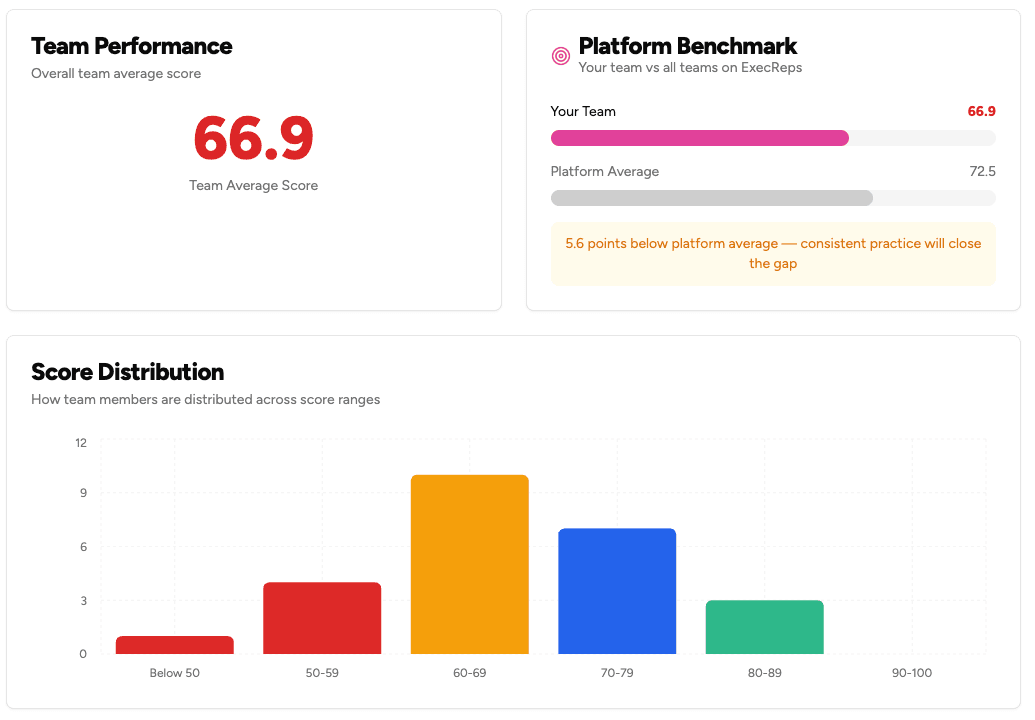
Get insights from The Lab
Weekly research on voice science, executive communication, and leadership development. No spam, unsubscribe anytime.