
Celebrating Your Champions: How to Recognize and Amplify Communication Growth
Part 5 of The Champion's Playbook Series
Celebrating Your Champions: How to Recognize and Amplify Communication Growth
You started this journey by asking a hard question: does my team have a communication problem? You built the business case. You launched the pilot. You turned scattered practice into sustained habit. And now — three, six, maybe nine months later — something has shifted. Your team communicates differently. Meetings are tighter. Presentations land harder. People who once deflected when asked to speak up are now volunteering.
That shift didn’t happen by accident. It happened because someone — probably you — championed a culture of practice.
This final post in The Champion’s Playbook series is about the most underrated phase of any development program: celebration. Not the confetti-and-cake kind (though that’s fine too). The kind that locks in behavior change, creates organizational visibility, and turns one team’s success into company-wide momentum.
Ready to develop your team's voice?
Start a free trial →Because here’s the truth: recognition isn’t vanity. It’s the mechanism that makes everything you’ve built actually last.
Why Celebration Is the Engine of Lasting Change
Behavioral scientist BJ Fogg, who spent decades studying habit formation at Stanford, puts it simply: “Emotions create habits. Not repetition. Not frequency. Not magic.”
Every habit loop has three phases: cue → routine → reward. Most L&D programs obsess over the cue (reminders, calendar blocks, manager nudges) and the routine (the training itself). Almost none invest in the reward — the emotional payoff that makes someone want to do it again.
That’s where celebration comes in. When someone completes their tenth ExecReps workout and hears “nice work” from their manager in a team standup, something fires in their brain that no push notification can replicate. They feel seen. They associate the practice with a positive outcome. And they come back.
Without that reward phase, even good practices decay. You’ve seen it before: the team that crushed Q1 engagement and quietly drifted by Q3. The gym membership that starts strong in January and expires in March. The difference between programs that stick and programs that fade is almost always the same: did anyone notice?
If you followed the engagement strategies in Making It Stick, you’ve already built the habit loop’s foundation. Celebration is what completes it.
What to Celebrate — and What Not To
Not all recognition is created equal. The wrong kind of celebration can actually undermine the culture you’re trying to build. Here’s the framework.
✅ Celebrate These
- Consistency: “Completed 10 workouts this month.” This rewards effort, not talent — and effort is the only thing fully within someone’s control.
- Improvement: “Improved Concise Messaging by 20 points since last quarter.” Growth over absolute score sends the message that everyone’s starting point is valid.
- Participation milestones: “First workout completed!” Momentum matters, especially early. Celebrating the start lowers the bar for everyone watching.
- Streaks: “Practiced every week for 8 weeks straight.” Streaks tap into our deep desire for continuity — nobody wants to break the chain.
❌ Avoid These
- Highest score: Spotlighting the person with the top score creates competition anxiety and discourages beginners from even trying. It rewards natural ability over effort.
- Comparing individuals: This violates ExecReps’ privacy-first design and makes the platform feel like surveillance, not development. The moment people feel ranked, psychological safety collapses.
- Perfect scores: Celebrating perfection implies a ceiling. It suggests the goal is to “finish” rather than to keep growing. There is no finish line in communication — only sharper edges.
Think of it like a gym analogy: you celebrate that someone showed up five days a week, not how much they can bench press. The person who went from zero push-ups to ten deserves more recognition than the person who’s always been able to do fifty.
Frame everything around practice, not performance. This single principle will protect the psychological safety that makes ExecReps work.
Monthly Recognition: The “Most Improved” Rhythm
The simplest, highest-impact celebration you can run takes five minutes in a team meeting once a month. Here’s how.
Step 1: Open Your Team Analytics Dashboard
Navigate to the improvement trajectories view. This shows you which skill dimensions saw the biggest score movement across your team over the last 30 days.
Step 2: Identify the Team-Level Win
You’re looking for the dimension with the largest collective improvement. Maybe it’s Executive Presence. Maybe it’s Concise Messaging. The dashboard makes this obvious — it’s the steepest upward line on the trend chart.
Step 3: Announce It at the Team Level
Here’s a template:
“Quick shout-out — this month, our team’s biggest improvement was +18 points in Executive Presence. Three team members drove that jump. You know who you are. Thank you for putting in the reps.”
Notice what this does: - It celebrates the team, not an individual (privacy-first) - It acknowledges that specific people contributed, without naming them - It creates curiosity — people wonder “was that me?” and check their own scores - It takes 30 seconds in standup
If individuals want to self-identify (“that was me!”), they absolutely can. But the choice is theirs. This respects ExecReps’ core design principle: the person owns their data.
For teams that use Slack or Teams, you can post the same update in your team channel. A quick screenshot of the team dimension trend (which shows aggregate data only) adds visual impact without exposing anyone’s individual scores.
Quarterly Communication Awards: Make It Fun
Monthly shout-outs sustain momentum. Quarterly awards create moments — the kind people remember and talk about.
The key is to keep these low-stakes and lighthearted. This isn’t a performance review. It’s a celebration of people who leaned in.
Award Ideas
- 🔥 The Streaker — Longest unbroken practice streak. “Twelve weeks straight without missing a workout. That’s discipline.”
- 🧭 The Explorer — Tried the most different workout types. “Went from Board Presentation to Difficult Conversation to Elevator Pitch — no comfort zone left unchallenged.”
- 📈 The Climber — Biggest improvement across any single dimension. “Started at 45 in Structured Thinking, now sitting at 78. That’s not luck — that’s work.”
- ⏰ The Consistent — Practiced every single week of the quarter. “Thirteen for thirteen. Rain or shine.”
How to Run It
- Pull the data from your Team Analytics Dashboard (participation trends and improvement trajectories make this easy)
- Announce awards in a retro, all-hands, or team social — wherever your team already gathers
- If budget allows, pair it with something small: a $10 coffee card, a funny trophy, a custom Slack emoji
- Let winners opt in — announce the award category and ask if anyone wants to claim it publicly
The goal is to make ExecReps practice feel like something the team does together, not something individuals do alone in a browser tab. Collective identity drives collective behavior.
Connect Practice to Career Outcomes
This is the ultimate reward — and the one that turns skeptics into believers.
When someone on your team gets promoted, earns a stretch assignment, or nails a high-stakes presentation, connect the dots back to their practice. Not as the sole cause, but as a visible contributor.
Here’s what this looks like:
“One of our team members improved their executive presence scores by 30% over six months. Last week, they were promoted to Director. Communication skills didn’t get them promoted — but they made sure nobody questioned whether they were ready.”
Notice: no names. No individual scores shared without consent. Just the pattern made visible: practice leads to growth, growth leads to opportunity.
This is where the statistic hits hardest: 70% of promotions hinge on communication skills. Most professionals know this intuitively. What they don’t know is that there’s a way to systematically improve — and that your team has already proven it works.
When you connect ExecReps practice to real career outcomes, you transform the platform from “another L&D tool” into “the thing that helped me get promoted.” That’s a fundamentally different relationship, and it’s one that sustains itself without managerial pressure.
Team-Level Celebrations That Build Collective Pride
Individual milestones matter, but team-level celebrations create something even more powerful: shared identity.
Related Posts
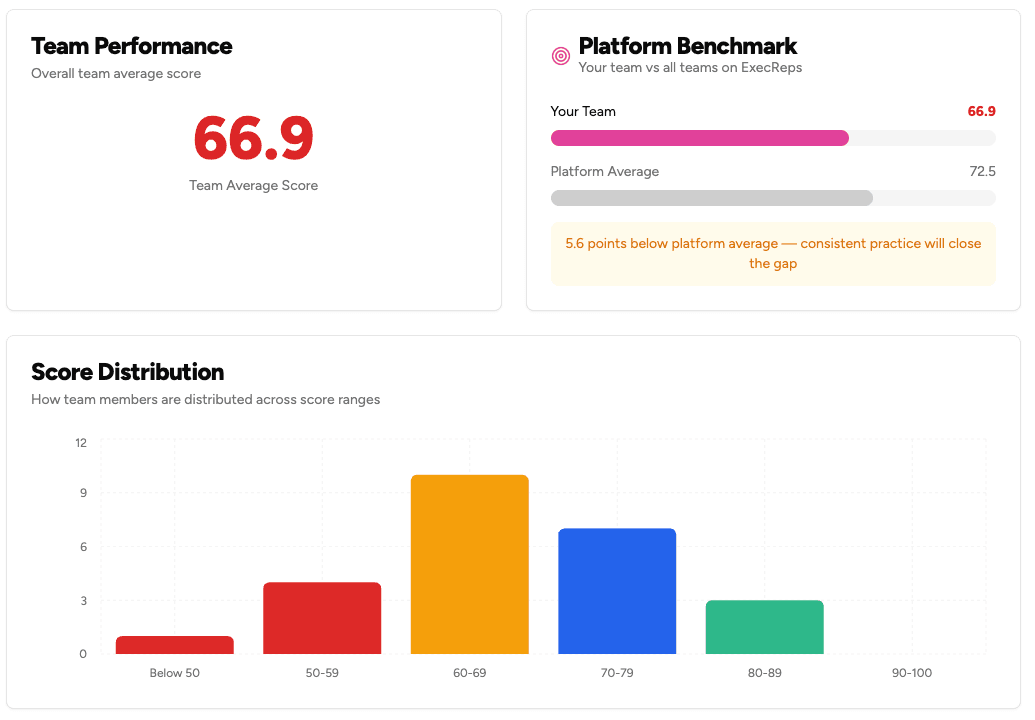
The Dashboard That Changes Everything: Why Team Communication Analytics Matter
Most teams fly blind on communication quality. ExecReps Team Analytics gives leaders the visibility to spot patterns, close gaps, and build genuine communication culture — not just hope for it.
5 min read
Launching Your First Team on ExecReps: The 30-Day Playbook
A week-by-week guide to rolling out AI communication coaching to your first team — covering champion selection, launch events, and early momentum strategies.
13 min read
Get insights from The Lab
Weekly research on voice science, executive communication, and leadership development. No spam, unsubscribe anytime.