
Making It Stick: How to Weave ExecReps Into Your Team's Culture
Part 4 of The Champion's Playbook Series

Making It Stick: How to Weave ExecReps Into Your Team’s Culture
You launched ExecReps. Your team completed onboarding. Scores are climbing. There’s a little buzz in the Slack channel. Everything feels… promising.
And if you’ve championed any L&D tool before, you know exactly what happens next. Week four: participation dips. Week six: only the keeners are logging in. Week ten: it’s another ghost icon on everyone’s bookmark bar, right between the wellness app nobody opened and the project management tool from two restructures ago.
Here’s the truth every L&D leader already suspects: the difference between a tool that transforms and a tool that dies isn’t the tool itself — it’s whether it becomes part of how your team already works. If you’ve followed our launch playbook, you’ve built a strong foundation. Now it’s time to make it permanent.
Ready to develop your team's voice?
Start a free trial →This post gives you 10+ concrete ways to embed ExecReps into your team’s existing rituals — so communication practice stops being “one more thing” and starts being “just how we work.”
Why Every Company Has an L&D Graveyard
Let’s be honest. Your company has a graveyard of abandoned learning tools. LinkedIn Learning licenses gathering dust. Mentorship programs that fizzled. That leadership cohort from 2023 that everyone loved in the moment and nobody applied afterward.
The pattern is always the same:
- Week 1–2: High energy, novelty, strong participation
- Week 3–5: Enthusiasm wanes, “I’ll do it later” becomes default
- Week 6–12: Only intrinsically motivated people persist
- Week 13+: Tool quietly removed from budget at next renewal
Research on behavior change tells us why. Stanford’s BJ Fogg Model breaks it down: Behavior = Motivation × Ability × Prompt. Most L&D programs nail motivation at launch (kickoff meetings, executive sponsors, team challenges) and ability is built into the product (ExecReps workouts are 3 minutes — it’s hard to get simpler than that). But the prompt — the trigger that reminds someone to actually do the thing at the right moment — is what almost every program misses.
That’s what this post is about: building prompts into the rituals your team already has.
You don’t need to create new meetings. You don’t need to add calendar blocks. You need to attach ExecReps to existing habits so practice happens almost automatically.
Here are 10 integration patterns. Pick three to start. You can always add more.
1. Monday Morning Rep: The Weekly Warm-Up
When: Before your Monday standup or weekly kickoff Time cost: 3 minutes per person Setup: Recurring calendar invite or Slack reminder
Athletes don’t walk onto the field cold. They warm up. The Monday Morning Rep works the same way: before the workweek officially starts, everyone completes one 3-minute ExecReps workout.
Here’s how to make it work:
- Admin assigns a “Workout of the Week” based on what the Team Analytics Dashboard shows. If the team is scoring low on Concise Messaging, that’s the workout. If a big client presentation is Thursday, it’s the Stakeholder Updates workout.
- Attach it to an existing trigger. The Monday standup calendar invite already exists — add a line: “Complete your Monday Rep before standup.” Or post a Slack reminder in your team channel at 8:45 AM.
- Keep it non-graded. The point isn’t performance — it’s priming. You’re warming up the communication muscles before a week of meetings, emails, and decisions.
The Monday Morning Rep works because it hijacks a habit you already have (Monday standup) and attaches a new micro-behavior to it. Over time, it stops feeling like an add-on and starts feeling like part of Monday.
2. Friday Replay: Beat Your Own Score
When: Last 15 minutes of the workweek Time cost: 3–5 minutes (one workout redo) Setup: Optional team channel post
Learning science calls it the spacing effect: revisiting material after a gap strengthens long-term retention far more than cramming. The Friday Replay puts this into practice.
The concept is simple:
- Look at your workouts from the week
- Find the one where you scored lowest
- Redo it
That’s it. No meeting. No group session. Just a personal challenge to close the week stronger than you opened it.
To make it social (without making it surveillance):
- Post in your team channel: “Friday Replay time — who beat their score this week?”
- Celebrate improvement, not absolute scores. Someone going from 52% to 67% deserves more recognition than someone coasting at 88%.
- Keep it optional but visible. The ambient social proof — seeing teammates post their wins — is the prompt that drives participation.
3. The Standup Slot: 30 Seconds of Reflection
When: During daily or weekly standups Time cost: 30 seconds per person Setup: Add one line to your standup template
Most standups follow a pattern: what I did, what I’m doing, any blockers. Add one more: “What workout did you do this week, and what surprised you?”
This works for several reasons:
- It creates social accountability without surveillance. Nobody shares scores — just reflections.
- It surfaces insights the whole team benefits from: “I did the Difficult Feedback workout and realized I always start with caveats instead of getting to the point.”
- It normalizes communication development as an ongoing practice, not a remediation exercise.
- It works in async standups too — add it as a thread prompt in your Slack or Teams standup channel.
The key: never make score-sharing mandatory. The moment someone feels judged by a number, the psychological safety that makes ExecReps effective evaporates. Focus on the learning, not the metric.
4. Sprint Retro & WIP Review Connection
When: End-of-sprint retrospectives or work-in-progress reviews Time cost: 5 minutes added to existing retro Setup: Add a communication dimension to your retro template
Sprint retros are already designed for reflection. Adding a communication lens makes the connection between practice and real outcomes explicit.
Try these retro prompts:
- “Did we communicate the demo clearly? What ExecReps workout would help next sprint?”
- “Were our standups tight this sprint, or did they drift? What does Team Analytics say about our Concise Messaging scores?”
- “We lost a stakeholder’s attention in the review. What dimension should we focus on?”
This is where the Team Analytics Dashboard becomes indispensable. When a manager can pull up the data and say, “We’re all scoring low on Concise Messaging — and our standups are running 15 minutes over. Coincidence?” — the team connects the dots themselves.
You’re not lecturing about communication skills. You’re using data to let the team diagnose their own patterns. That’s how buy-in happens organically.
5. 1:1 Development Conversations
When: Regular manager-report 1:1s Time cost: 2–3 minutes of an existing meeting Setup: Manager reviews Team Analytics before 1:1
Here’s what most managers say in development conversations about communication: “You should speak up more in meetings.” That’s not coaching. That’s a vibe.
With ExecReps, managers have actual data — Voice Performance Scores across 8 skill dimensions, tracked over time. That changes the conversation entirely:
- “I noticed your Stakeholder Updates scores jumped 15 points over the last month. What clicked for you?”
- “You mentioned wanting to present to the board next quarter. Let’s look at your Executive Presence dimension — you’re at 71%, and board-ready is usually 80%+. Want to focus there?”
- “Your Concise Messaging is already strong. Have you tried the Difficult Feedback workouts? That’s a growth edge for your next role.”
This matters especially for professionals who are statistically undercoached. Research shows 0% of mid-level professionals receive structured communication development — it’s all reserved for the C-suite. ExecReps in 1:1s democratizes what used to be a $500–$1,000/hour executive coaching privilege.
Critical framing for managers: VPS trends are development data, not performance reviews. The moment scores become punitive, people stop practicing honestly. Use them the way you’d use a runner’s mile times — to track progress and set goals, not to decide who gets fired.
6. All-Hands & Town Hall Prep
When: Before any company-wide or cross-functional presentation Time cost: 3–10 minutes (1–3 workouts) Setup: Ad hoc, triggered by upcoming presentations
Every team has presentation moments: quarterly business reviews, all-hands updates, client demos, board readouts. These are high-stakes, high-visibility — and most people prepare the slides but never practice the delivery.
Make ExecReps the pre-game warmup:
- Presenting Q2 results? Do the “Presenting Financial Results” workout.
- Running a cross-functional kickoff? Practice “Stakeholder Alignment.”
- Delivering difficult news to the team? Hit “Difficult Feedback” and “Leading Through Uncertainty.”
The analogy writes itself: athletes don’t walk into the championship without reps. Neither should your team walk into an all-hands without warming up their voice.
Over time, the prompt becomes instinctive. Calendar invite for a big presentation triggers a thought: “I should do a quick ExecReps session first.” That’s the habit loop closing.
7. New Hire Onboarding
When: First week of employment Time cost: 15–20 minutes total (3 workouts across the week) Setup: Add to onboarding checklist alongside Slack, email, and badge access
This one is sneaky powerful. When you add ExecReps to the onboarding checklist, you signal something to every new hire before they’ve attended their first meeting: “We invest in communication here. It matters.”
Related Posts

Celebrating Your Champions: How to Recognize and Amplify Communication Growth
Learn how to celebrate team members who invest in their communication skills — and turn individual wins into organizational momentum.
13 min read
Launching Your First Team on ExecReps: The 30-Day Playbook
A week-by-week guide to rolling out AI communication coaching to your first team — covering champion selection, launch events, and early momentum strategies.
13 min read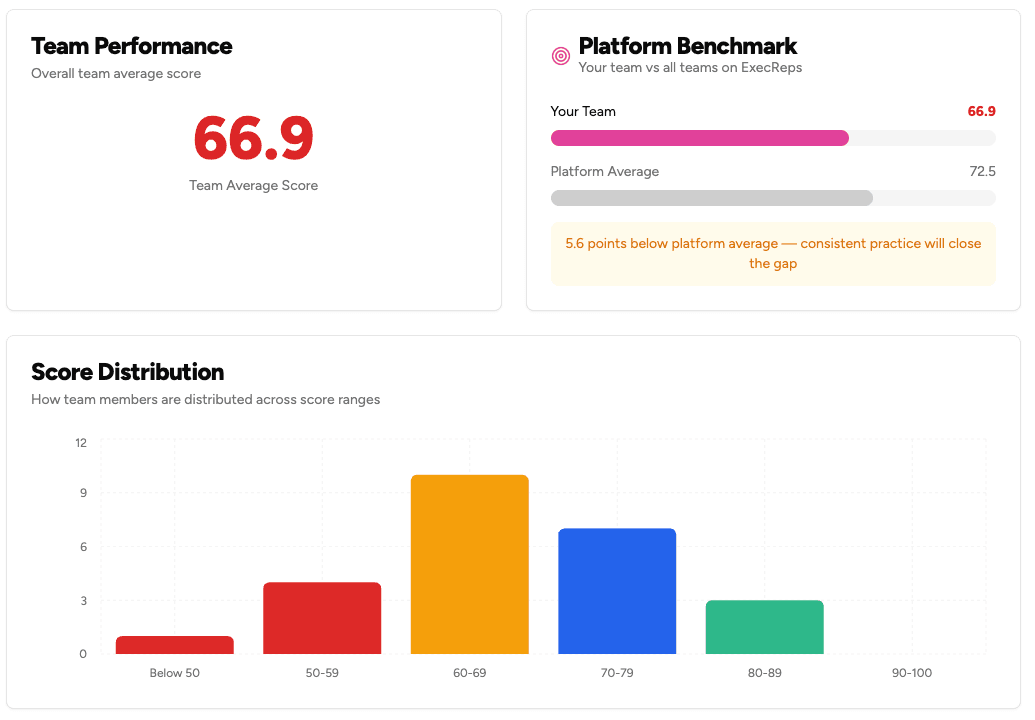
Get insights from The Lab
Weekly research on voice science, executive communication, and leadership development. No spam, unsubscribe anytime.